
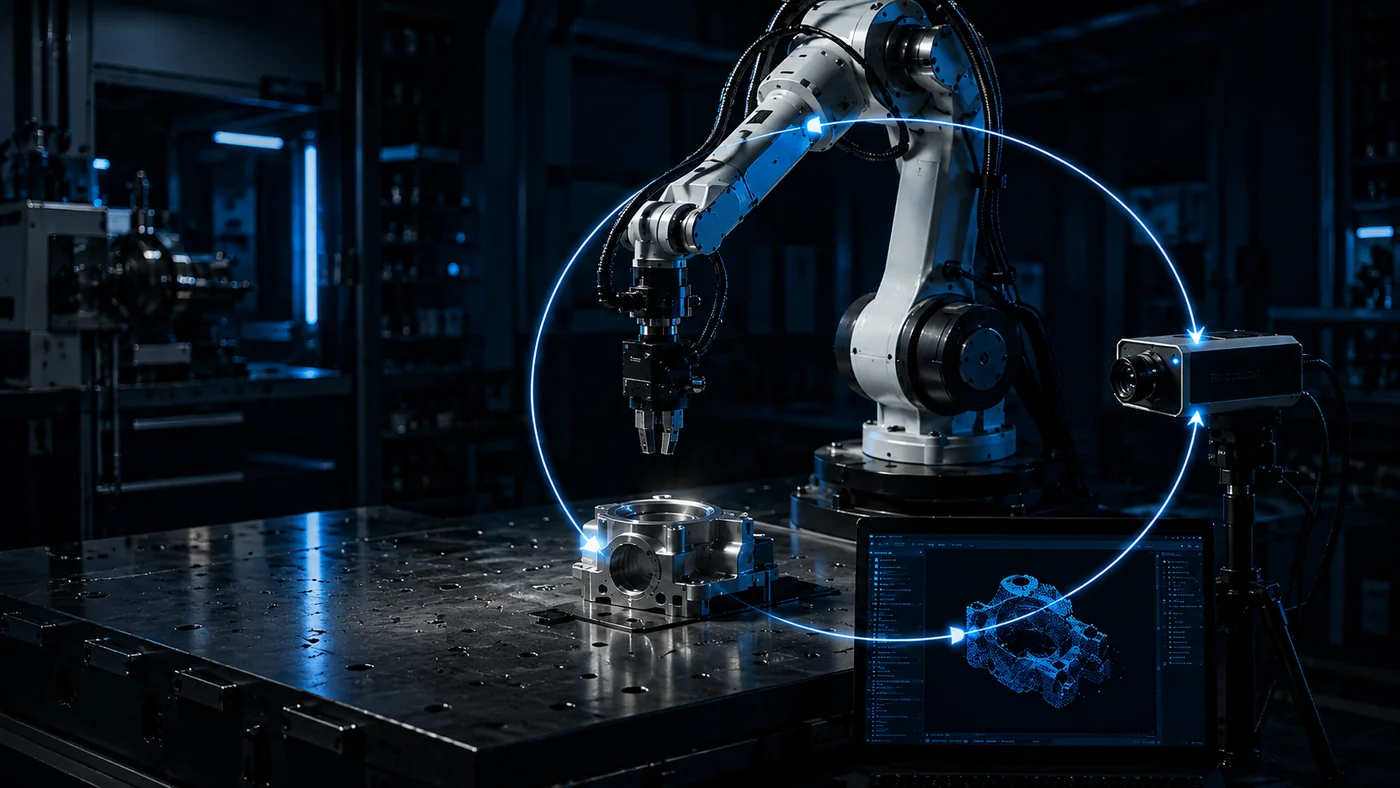
A preface to the Foundation Series
Robotics is becoming easier to see and harder to understand.
Not because progress has slowed, but because so many things are improving at once. Hardware is becoming more accessible. Models are growing more capable. Compute continues to scale. Simulation is becoming genuinely useful. Toolchains are getting better. As a result, more people can now build systems that, at least for a moment, seem astonishingly capable.
And once a field starts producing convincing moments, it also starts producing bad language.
Robotics is now described through demos, labels, market categories, and partial abstractions that blur more than they clarify. A robot becomes a humanoid, a foundation model on wheels, a warehouse product, a digital twin, an embodiment layer, a learned policy, a fleet-level system, or simply “AI in the physical world.” Some of these terms point toward something real. None is an adequate unit of analysis.
That is why this series exists.
Its purpose is not to promote a platform, decorate a trend, or stage one more argument in which the latest fashionable method supposedly renders the rest of engineering obsolete. It is to recover a way of seeing that becomes harder to hold precisely when the technology becomes more impressive. Robotics is not the assembly of advanced components. It is the engineering of coupled systems that must sense, estimate, decide, and act while the world keeps changing.
That sounds straightforward.
It is not.
A camera frame arrives a fraction too late. The estimate is already stale when the controller receives it. A gripper closes on where the object was, not where it is. Contact happens off-axis. Recovery works once, then fails on the third repetition as timing, tolerance, and wear begin to interact. Nothing in that sequence is dramatic by itself. Together they are robotics.
Much of the confusion begins with the wrong mental image. We picture robots as visible embodiments of intelligence and then ask whether that intelligence is fluent, general, natural, or humanlike. Or we imagine robotics as a stack of modules and then ask whether the perception system, planner, controller, or model is state of the art. Both perspectives miss what matters most. A robot does not succeed because its parts are individually sophisticated. It succeeds when those components remain compatible as a system under feedback, uncertainty, delay, and the pressures of real-world operation.
This series is written to keep that systemic reality in clear view.
Against the Component Illusion§
The weakest way to think about robotics is through the component frame: the idea that the field can be understood mainly by listing capabilities and subsystems. Better perception. Better planning. Better policies. Better hardware. Better models. Better autonomy.
The appeal of this frame is easy to see. It mirrors the classic divide et impera instinct of computer science: split the problem into parts, improve each part, and assume the whole will improve with them. No serious system is built without some form of decomposition. It is necessary. But decomposition can harden into a false ontology. It suggests that progress is mostly additive, that better modules naturally sum to better robots, and that whatever still makes robotics hard is only an implementation detail lingering at the edges.
Embodied systems are not so accommodating.
A robot must close a loop through a world that does not pause while software deliberates. Sensors do not deliver finished truth. They return partial, noisy measurements. State must be inferred. Plans must be formed under uncertainty. Commands pass through actuators burdened by delay, saturation, compliance, and wear. Contact reshapes the task. Repetition reshapes the machine. And deployment changes the problem again, introducing maintenance, resets, operators, update pathways, and organizational constraint.
The deeper lesson is that robotics is hardest at the seams: where measurement becomes estimation, where estimation becomes action, where kinematics meets force, where timing meets control, where a locally competent subsystem enters a globally fragile architecture, and where laboratory success is forced to survive ordinary operation.
That is where this series chooses to look.
A Sequence, Not a Survey§
These essays are not a textbook and not a survey. They are a sequence of arguments. Each one isolates a condition that robotics must satisfy if action in the physical world is to remain valid.
The early essays establish the systems picture directly. They argue that a robot is not a software pipeline but a closed-loop embodied system, then ask what that claim means once it is made precise. From there the series moves through the constraints such a system cannot escape: time, partial observability, state estimation, kinematics, dynamics, stability, planning, and learning.
Later essays widen the aperture. They ask what happens when competence has to survive repeated deployment, accumulated failure, fleet-scale coordination, and the newer language now gathered under physical AI. By that point the question is no longer whether one machine can work once. It is whether competence can be measured, sustained, updated, and trusted across time.
That order matters. If the reader enters the series looking first for the latest architectural fashion, the later essays may seem overly severe. The severity is part of the point. New methods matter. They just enter a field whose older constraints remain fully in force.
The essays therefore build a systems view of robotics rather than a stack of opinions. Each chapter tries to narrow the space of confusion by making one distinction harder to evade than before.
What Remains True Even Now§
AI has changed robotics. Learning has expanded what robots can perceive, infer, represent, and sometimes even execute. Modern models are not a distraction from the field. They are now part of it.
But they enter a domain whose older constraints remain fully in force. Better models may enlarge what fits inside the loop. They do not abolish the loop. They do not repeal latency, partial observability, calibration drift, contact dynamics, inertia, hardware limits, reliability, maintenance, or operational complexity.
That is the actual claim of this series. Not that AI does not matter, but that it matters inside a system that still has to remain coherent under feedback, uncertainty, delay, and force. If anything, richer models raise the penalty for misunderstanding those conditions, because they make superficial competence easier to display in public.
That is why the series insists on a systems vocabulary. Not because systems language is old, but because it remains the most honest language available for saying what has to remain true when a machine leaves the lab and starts acting in the world.
The Harder Standard§
The field now contains too many claims that are visually persuasive and operationally weak.
A good demo may still matter. A benchmark may still reveal something real. A compelling policy may still represent serious technical progress. But none of these is enough by itself. Once robots are treated as systems rather than as performances, the standard of evidence changes.
The more useful questions become harsher and more measurable. What is the observation-to-actuation latency? How stale is the estimate when the command is issued? How large is the tracking error under load? How long does recovery take after disturbance? How often does the system require intervention in deployment? At scale, how much coordination overhead can the fleet absorb before performance degrades?
Those are not secondary metrics. They are ways of asking whether the internal assumptions of the machine still agree with the world closely enough for action to remain valid.
If that sounds less glamorous than current public language around robotics, so be it.
The field does not need more glamour. It needs better units of truth.
A Field Crossing a Threshold§
This is a good moment for a foundations series because the field is crossing a threshold. Robotics is no longer confined to industrial automation on one side and research prototypes on the other. It is becoming entangled with large-scale AI, operational infrastructure, teleoperation, simulation, logistics, developer tooling, and increasingly public expectation.
The shift is broader than robotics in the narrow sense. Across laboratory automation, wearable sensing, medical devices, teleoperated systems, and new human-machine interfaces, intelligence is being pushed into systems that must do more than classify, predict, or describe. They must remain coupled to the world through measurement, action, adaptation, and consequence.
Several domains that once looked separate are beginning to share a deeper substrate. They depend on models of physical dynamics, architectures for embodied action, synthetic and real data pipelines, richer sensing, continuous telemetry, and the ability to sustain closed-loop operation over time.
That matters because the loop is no longer only an algorithmic matter. Just as digital AI emerged from the convergence of compute, algorithms, storage, bandwidth, and data, physical AI depends on a substrate of its own: sensors that can observe with sufficient fidelity, actuators that can apply force with repeatable control, simulation and synthetic-data pipelines that shape behavior before deployment, connectivity that keeps machines coordinated, telemetry that makes failure legible, and update pathways that improve behavior without destabilizing the whole.
In embodied systems, infrastructure is not peripheral. It is what makes the operational loop timely, observable, correctable, and sustainable.
That expansion makes clarity more important, not less. Without a disciplined frame, every new capability gets misread. We mistake semantic fluency for operational competence. We mistake one successful run for reliability. We mistake architectural novelty for physical adequacy. We mistake scale in models for scale in systems. We mistake visibility for understanding.
And because these adjacent domains increasingly reinforce one another by generating new forms of grounded data, new infrastructure demands, and new operating conditions, the cost of conceptual confusion rises with the apparent pace of progress.
This series is written against those mistakes.
For Readers Who Want Mechanisms§
The intended reader is technically literate and impatient with hand-waving. Perhaps you are a roboticist. Perhaps you build software and want to understand why physical systems behave so differently. Perhaps you come from controls, machine learning, mechanical engineering, autonomy, infrastructure, or operations.
Perhaps you are entering the field through the newer language of physical AI and want a sturdier frame than the market currently offers. That instinct is reasonable. Something broader is indeed happening. But if physical AI is to mean anything serious, it cannot mean software attached to hardware. It must mean systems that can sustain valid action, inference, and adaptation in the physical world, and that can do so through the substrate real operation demands: sensors, actuators, onboard compute, power systems, clocks, network links, middleware, telemetry pipelines, recovery procedures, and update pathways. That is a higher bar than current language often admits, and it is the bar this series takes as foundational.
What I hope to provide is not a comprehensive map of everything robotics contains. It is a compact set of distinctions that let the reader look at the field and ask better questions.
If the series succeeds, it should alter the reader's reflexes. The reader should become less impressed by isolated capability and more attentive to how the parts work together. Less persuaded by category labels and more interested in mechanisms. Less tempted to ask whether a robot appears intelligent, and more inclined to ask what must remain aligned for its behavior to stay valid.
That is a more severe standard.
It is also a more satisfying one.
Begin With The Loop§
The series starts from a simple claim and returns to it repeatedly: robotics begins when computation enters the causal structure of the physical world.
Everything else follows from that.
The moment a machine must act under uncertainty, latency, feedback, force, friction, and constraint, robotics stops being a story about elegant components. It becomes a story about coherence under pressure. Can perception, control, mechanics, software, and intent hold together while the world pushes back?
That is the loop.
And that is where robotics begins.