
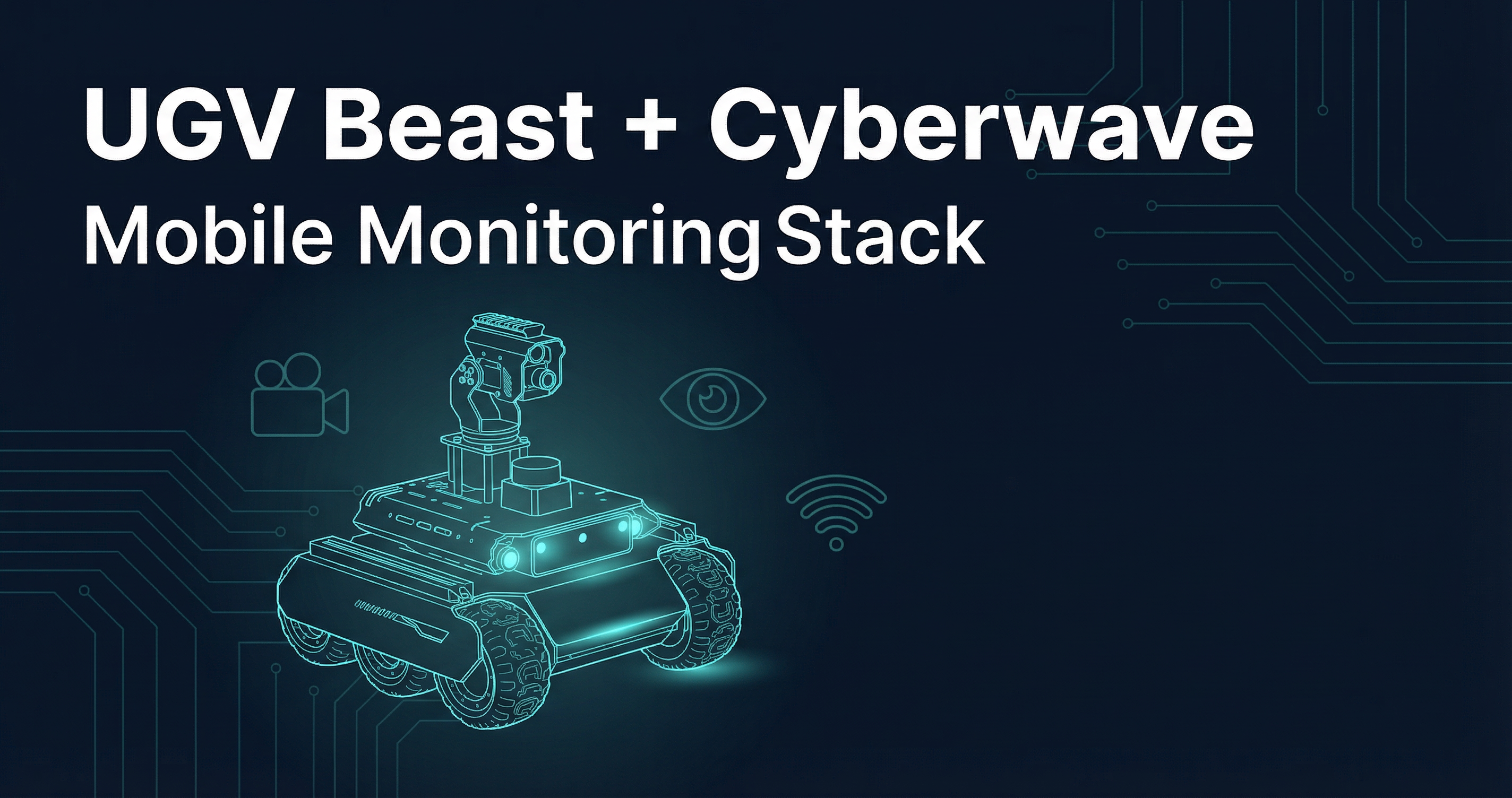
UGV Beast + Cyberwave: A Mobile Monitoring Stack That Sees, Reasons, and Acts§
Monitoring physical spaces is not just about visibility. It is about knowing what is happening, where it is happening, and being able to respond quickly.
Whether you are keeping an eye on a property, a worksite, or any environment that needs regular checks, conditions change constantly:
- An unexpected obstacle blocks a path.
- Something looks out of place or potentially unsafe.
- A subtle change goes unnoticed until it becomes a bigger problem.
Most monitoring setups remain camera-centric and reactive: fixed viewpoints, manual review, delayed response, and limited ability to gather context at the location of an event.
The Cyberwave stack closes that gap by combining mobile sensing with policy-driven orchestration and verifiable outcomes.
Why Mobile Monitoring Matters§
Most monitoring setups still depend heavily on fixed cameras and manual review. That approach struggles with three real constraints:
- Coverage gaps: Fixed cameras cannot move to the exact spot where context is needed.
- Attention fatigue: No one can continuously watch dozens of video feeds without missing things.
- Slow response loops: Detection and response are often disconnected systems.
What better monitoring looks like is an architecture that is:
- Mobile in sensing
- Context-aware in analysis
- Automated in response
- Verifiable in outcomes
What Is UGV Beast?§
UGV Beast is a mobile ground robot designed to go where fixed cameras cannot. It provides on-demand perception for any space that needs monitoring. Core capabilities include:
- Live video for remote situational awareness (teleoperation/telemotion workflows)
- Active illumination for low-light and nighttime operation
- Remote mobility to approach points of interest and capture the right viewpoint
Instead of waiting for an issue to appear inside a fixed camera frame, UGV Beast brings sensing to the problem area.
Where Cyberwave Comes In§
UGV Beast provides the physical mobility and sensing. Cyberwave provides the orchestration layer that makes it scalable.
Cyberwave functions as an edge-to-cloud control plane:
- Unified data layer: sensor streams, joint states, camera feeds, and telemetry all land in one standardised format instead of being scattered across different devices, protocols, and file types
- Digital twin pairing: synchronizes robot state, location, and context with an operational model
- Video ingestion: streams camera data into the twin context for correlation with zones and workflows
- Automated frame analysis: runs scheduled and event-triggered vision checks (e.g., anomaly detection, area checks)
- Policy and decision layer: evaluates detections against defined rules and procedures
- Action dispatch: issues robot actions (reorient camera/lighting, request teleop) with traceable outcomes
The result is not "robot + dashboard," but a monitoring pipeline that can sense, interpret, decide, act, and log evidence.
The Use Case: A Closed Monitoring Loop§
The system implements a straightforward monitoring loop:
- UGV Beast streams live camera data to the Cyberwave digital twin.
- Cyberwave passes sampled frames to a model at regular intervals for monitoring checks.
- If an issue is detected, Cyberwave sends instructions to UGV Beast.
- UGV Beast executes an action based on its configured policy.
Monitoring Loop in Detail§
The monitoring loop for UGV Beast + Cyberwave can be implemented in five clear stages:
1) Connect UGV Beast to Cyberwave§
Using the Cyberwave SDK, establish a bidirectional communication layer between the robot and the platform.
This connection enables:
- Real-time video streaming from UGV Beast's integrated camera
- Synchronization of live data into Cyberwave's digital twin
- A control path for sending instructions back to the robot
At this point, Cyberwave becomes the operational interface for both perception and control.
2) Set Up Controllers§
Cyberwave lets you control UGV Beast directly from the Cyberwave platform using configurable controller policies. Options include:
- Keyboard control: drive the robot with WASD or arrow keys for quick manual operation
- Custom controller policies: define reusable control schemes tailored to your robot's capabilities
This gives you hands-on control whenever you need it, whether for initial setup, manual inspections, or overriding automated behavior.
3) Train and Deploy Robot Behavior Models§
Record episodes of UGV Beast performing specific actions in representative environments, then train models on that dataset.
This stage includes:
- Collecting action episodes (for example: move, inspect, stop, reposition)
- Labeling and organizing data for training
- Training and validating model behavior on expected tasks
- Deploying models for runtime use on the robot control layer
The goal is to make UGV response behavior predictable, repeatable, and aligned with monitoring requirements.
4) Build the Automation Workflow in Cyberwave§
Using UGV Beast's real-time video as the input layer, create a workflow in Cyberwave that:
- Ingests the latest frame/video data from the twin
- Passes it into an LLM for monitoring checks
- Applies custom prompts to evaluate your monitoring criteria
- Produces a structured output (pass/fail, class, or action signal)
This is the intelligence layer that translates visual observations into actionable outcomes.
5) Execute Real-Time Actions§
Use the workflow output layer to send instructions back to UGV Beast.
Based on the workflow output and configured policies, the robot executes actions in real time, such as:
- Stopping and holding position
- Repositioning for better camera coverage
- Adjusting lighting or camera angle
- Following predefined action policies
This closes the loop from visual monitoring to physical response in the same system.
What Differentiates This Stack§
UGV Beast + Cyberwave is not just surveillance plus a robot UI. It is a complete operational loop:
- Observe with mobile sensing
- Reason with AI in context
- Act through robot control
- Verify with post-action evidence
That progression is what makes this a next-generation monitoring stack.
Practical Value§
For anyone managing a physical space, this architecture can deliver:
- Faster detection and response times
- Less time spent manually reviewing camera feeds
- Expanded coverage beyond static cameras
- Traceable logs of what was detected and what actions were taken
- A clear path toward smarter, more hands-off monitoring
Final Thoughts§
Monitoring is shifting from passive recording to active response systems.
With UGV Beast as the mobile sensing layer and Cyberwave as the orchestration and decision layer, monitoring becomes operational: detect, evaluate, act, and verify within one coordinated system.
That integration defines the new monitoring stack.